Chapter 4 · SVYX Tokenomics
With the utility token SVYX as the value carrier, deflationary burning, staking incentives and community governance keep the ecosystem healthy.

4.1 Token overview
| Parameter | Detail |
|---|---|
| Token name | Synavoryx Token (SVYX) |
| Token type | Ecosystem utility token |
| Total supply | 560,000,000 SVYX |
| Supply mechanism | Fixed at 560 million, no further issuance |
| Core utilities | Payment · staking · governance · incentives |
| Deflation mechanism | Fee burning + periodic buyback & burn |
| Governance mechanism | Staking-weighted voting on community proposals |
4.2 A fixed supply with a deflationary path
The supply is fixed at 560 million SVYX with no further issuance. Long-term deflation is achieved through automatic burning: approximately 20% of the initial supply is intended to be burned cumulatively, leaving final circulation around 80% of the initial total — approximately 448,000,000 SVYX.
| Milestone | Supply |
|---|---|
| Initial total supply | 560,000,000 SVYX |
| Long-term burn target | 20% |
| Resulting circulation | ~448,000,000 SVYX (80%) |
4.3 Utility scenarios
Ecosystem service payment
SVYX is used to pay for compliant Web3 application services, digital resources and platform features — the fundamental settlement medium within the ecosystem.
AI computing and data services
Exploring usage in AI tool calls, data authorization and computing-resource collaboration, enabling pay-as-you-go intelligent services.
Metaverse digital economy
Supporting platform-compliant digital goods, virtual services and in-ecosystem value exchange, activating commercial scenarios in virtual worlds.
Network contribution incentives
Under formal mechanisms, developers, testers and ecosystem contributors receive corresponding incentives, rewarding the builders of the ecosystem.
Community governance participation
Where technically and legally feasible, exploring community proposals and governance mechanisms that let holders participate in key decisions.
All utility scenarios above are planning and research directions. Specific features depend on subsequent technical development, product launches and compliance review.
4.4 Token allocation
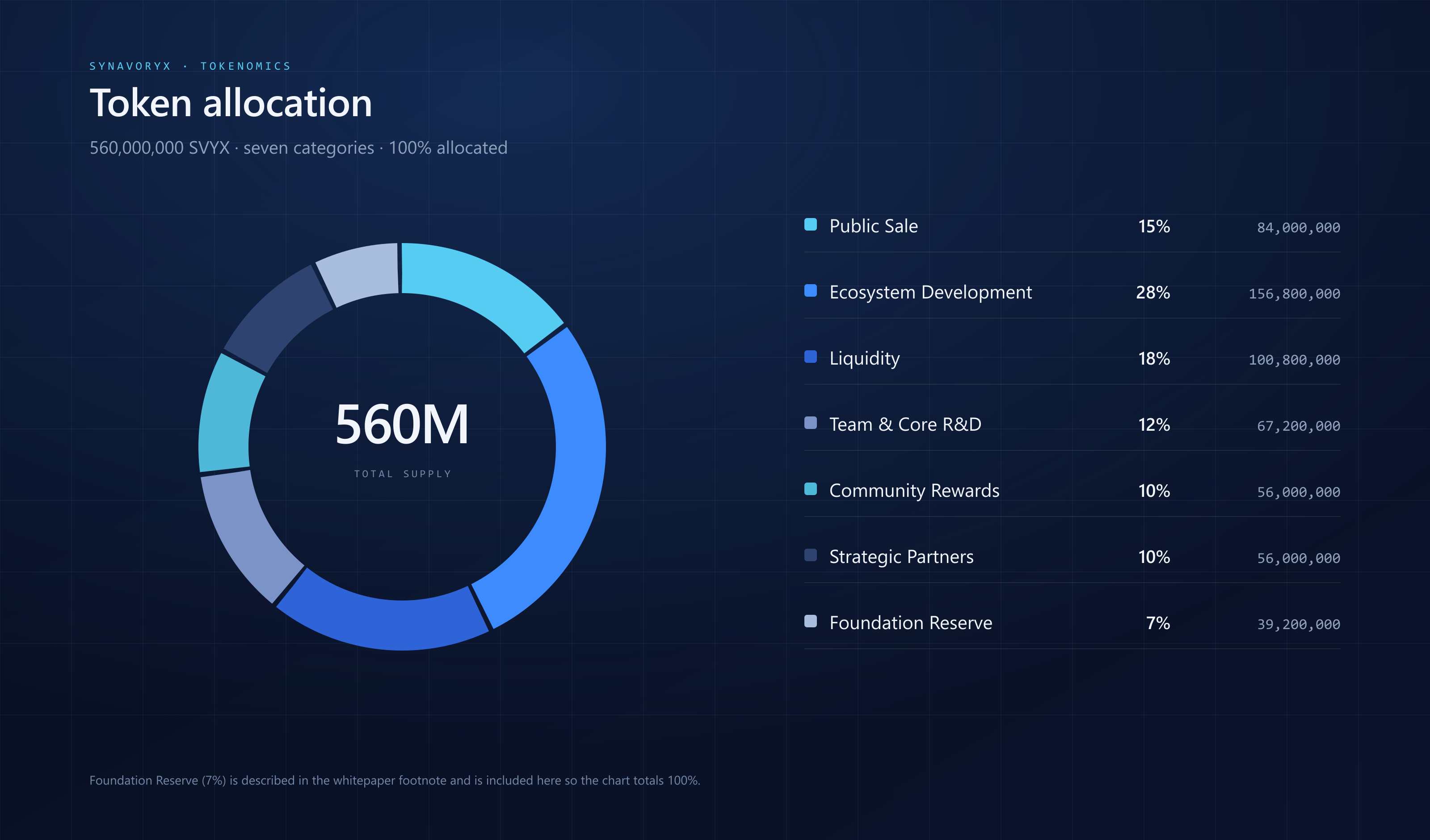
| Category | Ratio | Amount (SVYX) |
|---|---|---|
| Public Sale | 15% | 84,000,000 |
| Ecosystem Development | 28% | 156,800,000 |
| Liquidity | 18% | 100,800,000 |
| Team & Core R&D | 12% | 67,200,000 |
| Community Rewards | 10% | 56,000,000 |
| Strategic Partners | 10% | 56,000,000 |
| Foundation Reserve | 7% | 39,200,000 |
| Total | 100% | 560,000,000 |
The Foundation Reserve accounts for 7% (39,200,000 SVYX), used for long-term ecosystem operations and strategic reserves, with usage determined by the governance mechanism.
4.5 Deflation and auto-burn
Three sources feed the burn process:
- Ecosystem fee burning. A portion of transaction and service fees within the ecosystem is automatically sent to the burn address at a set ratio, scaling with ecosystem activity.
- Periodic buyback and burn. The Foundation periodically uses part of ecosystem revenue to buy back SVYX from the open market and burn it, verifiable on-chain.
- Scenario penalty burning. Tokens forfeited in certain scenarios — for example default liquidation or early unstaking — go directly into the burn process.
The auto-burn contract is designed around transparent rules and on-chain verifiability. After 20% of the initial supply is burned, the mechanism automatically slows into dynamic equilibrium.
All burn records are intended to be published on-chain and publicly verifiable. Parameters are planning directions, subject to contract deployment and official announcements.
4.6 Vesting and release schedule
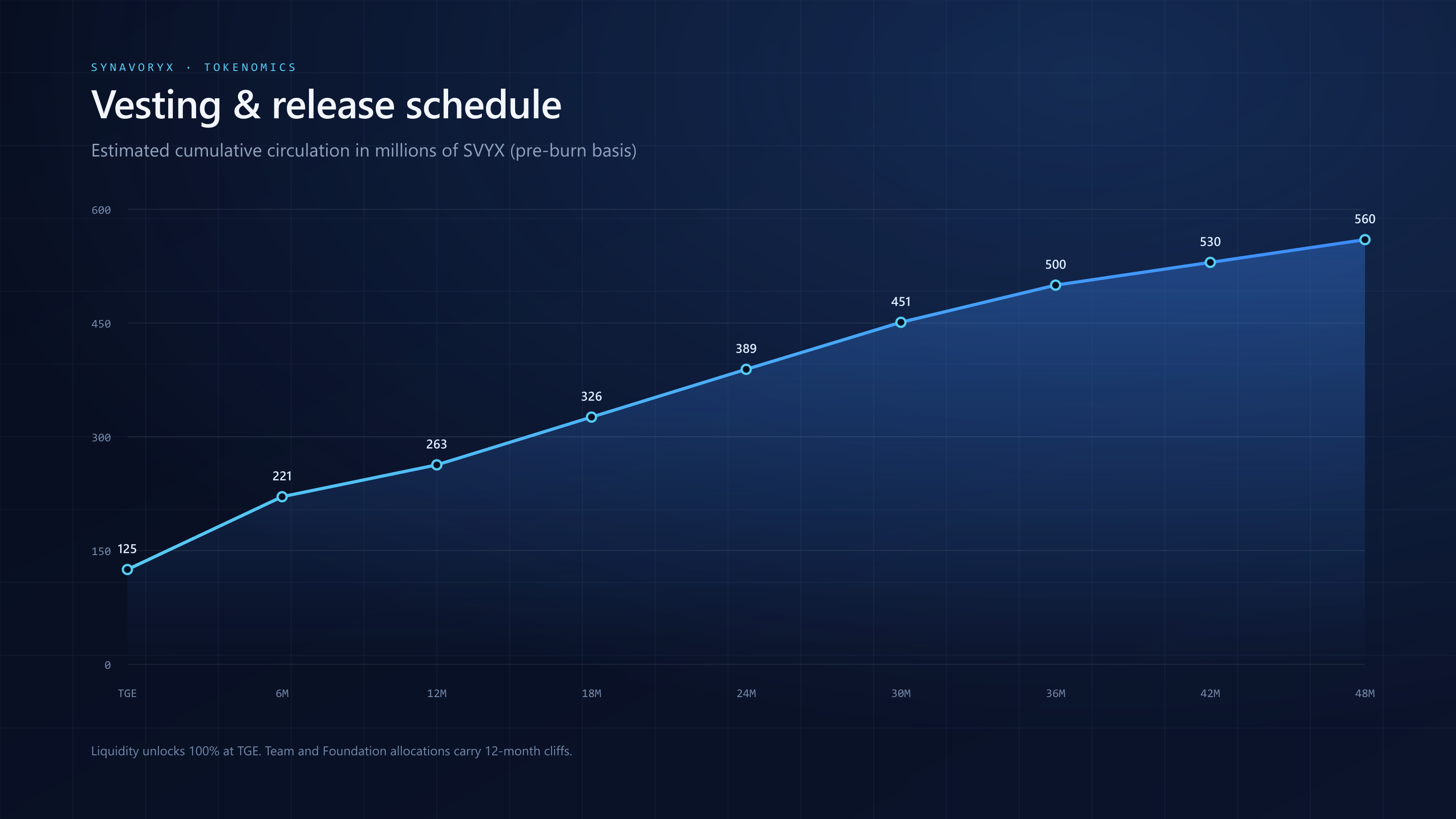
| Allocation | Release rule |
|---|---|
| Liquidity | 100% released at TGE for market making and liquidity pools |
| Public Sale | 20% at TGE, remainder linear over 6 months |
| Ecosystem | 5% at TGE, remainder linear over 48 months |
| Community Rewards | Linear over 36 months per incentive plan |
| Strategic Partners | 6-month cliff, then linear over 24 months |
| Team & Core R&D | 12-month cliff, then linear over 36 months |
| Foundation Reserve | 12-month cliff, then linear over 24 months |
The curve shows estimated cumulative circulation under planning assumptions (pre-burn basis). Actual release is subject to smart contract execution and official disclosure. Final token standards, issuance network and mechanism parameters are subject to official announcements prior to mainnet launch.