Chapter 2 · Ecosystem Architecture
Five mutually reinforcing development directions form a layered ecosystem technology system, with compliance embedded throughout.
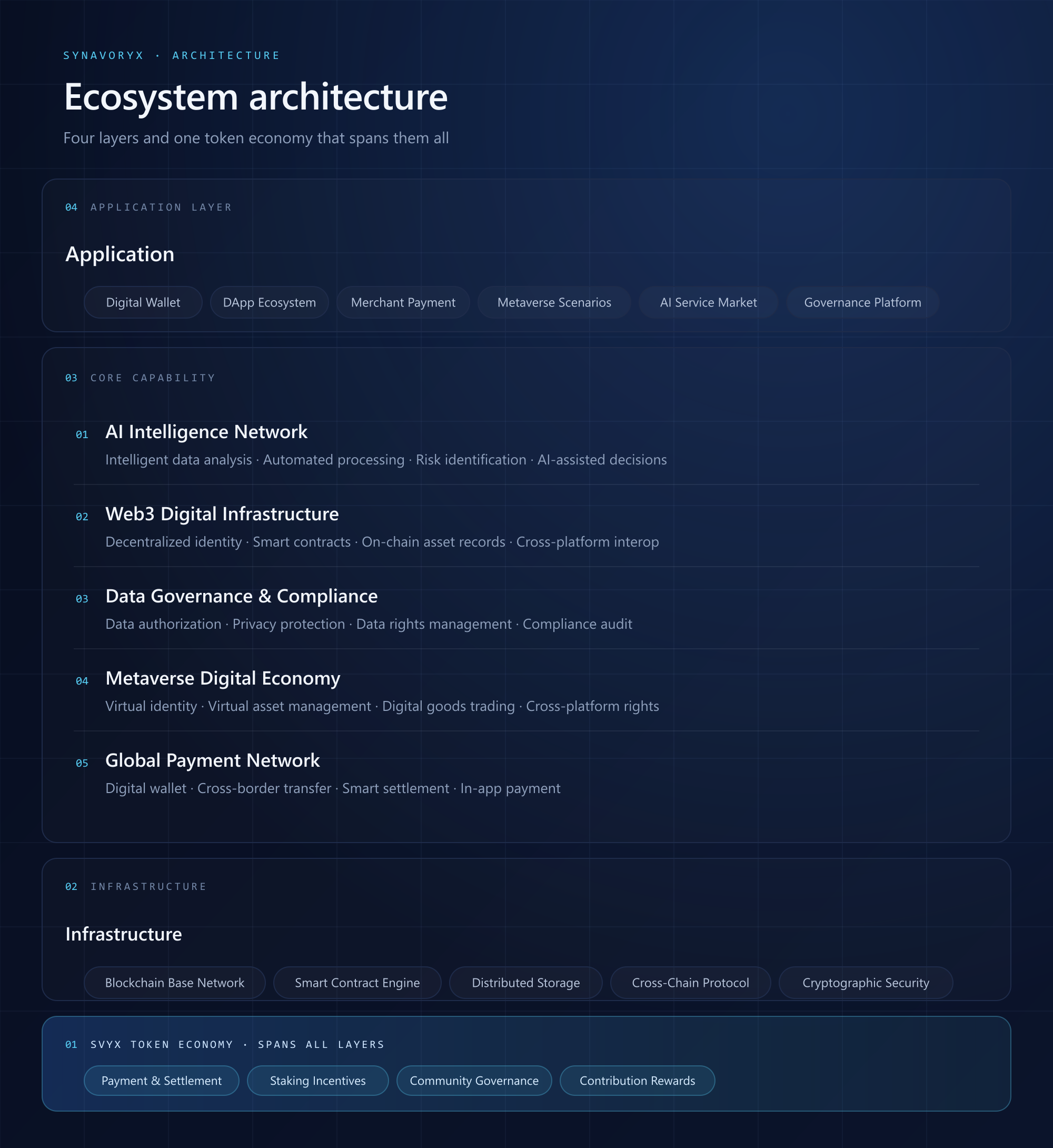
2.1 The four-layer stack
The architecture separates what users touch, what creates value, what connects the physical and digital worlds, and what makes the whole system trustworthy.
| Layer | Function | Components |
|---|---|---|
| Application layer | The experiences and entry points users interact with | Digital wallet · DApp ecosystem · merchant payment · metaverse scenarios · AI service market · governance platform |
| Core capability layer | The five engines that create differentiated value | AI intelligence · Web3 infrastructure · data governance · metaverse economy · global payments |
| Infrastructure layer | Shared technical foundations | Blockchain base network · smart contract engine · distributed storage · cross-chain interoperability · cryptographic security |
| SVYX token economy | The value and coordination layer spanning every level | Payment and settlement · staking incentives · community governance · contribution rewards |
Application layer
The application layer is where ecosystem participants meet the network: a digital wallet as the primary identity and asset interface, a DApp ecosystem for third-party builders, merchant payment tools, metaverse scenarios, an AI service marketplace, and the governance platform through which the community participates.
Core capability layer
The core capability layer holds the five pillars described in section 2.2. Each pillar is a research and development direction with its own product surface, but they share identity, data and settlement primitives so that value created in one pillar can circulate in the others.
Infrastructure layer
The infrastructure layer supplies the trust foundation: a high-performance consensus network, a smart contract engine, distributed storage, cross-chain protocols and cryptographic security modules. Applications do not need to rebuild these primitives; they inherit them.
SVYX token economy
The token economy is not a separate product layer. It runs through every layer as a coordination mechanism — settling payments, rewarding contribution, pricing services, and weighting governance.
2.2 The five capability pillars
2.2.1 AI Intelligence Network
Exploring real-world applications of AI in the digital economy — letting AI participate deeply in data analysis, business processing and on-chain interaction.
- Intelligent data analysis. Intelligent modeling of on-chain and ecosystem data, delivering actionable business insights.
- Automated business processing. Agents execute repetitive business processes automatically, cutting labor and operating costs.
- Risk identification. Real-time detection of abnormal transactions and contract risks, with early warnings for participants.
- Smart contract interaction and AI-assisted decisions. AI combined with Web3 infrastructure assists users with on-chain operations and decisions.
2.2.2 Web3 digital infrastructure
Exploring decentralized identity, smart contracts, on-chain asset records and cross-platform interoperability — providing individuals, enterprises and developers with an open foundation for digital collaboration.
- Decentralized identity (DID). User-controlled, verifiable digital identity that is portable across platforms with controllable privacy.
- Smart contracts. Self-executing contract logic carrying the ecosystem's core rules for payment, authorization and incentives.
- On-chain asset records. Asset ownership and transfers recorded on-chain — transparent, auditable and tamper-proof.
- Cross-platform interoperability. Connecting asset and data flows across chains and platforms, lowering the barrier to collaboration.
2.2.3 Data governance & compliance
Researching how blockchain, cryptography and smart contracts can improve the transparency, traceability and security of data usage, and support applications in complying with applicable data protection laws.
- Data authorization. Fine-grained data authorization through smart contracts puts data owners in control.
- Privacy protection. Cryptographic techniques balance data availability with privacy security.
- Data rights management. Confirming, metering and distributing data value so contributors share in ecosystem returns.
- Compliance audit. On-chain traceability with end-to-end auditability supports compliance with data protection regulations.
2.2.4 Metaverse digital economy
Exploring the connection between virtual worlds and real-world commerce, with technical support across identity, assets, transactions and rights.
- Metaverse digital identity. Avatars bound to trusted real-world identities enable identity portability across virtual scenarios.
- Virtual asset management. Ownership confirmation, valuation and secure management of virtual land, equipment and digital collectibles.
- Digital goods trading and virtual commerce. Supporting issuance and trading of digital goods and settlement for virtual commercial spaces.
- Cross-platform digital rights. Circulation and redemption of digital rights across platforms, enhancing user asset value.
2.2.5 Global digital payment network
Through scalable digital payment infrastructure, lowering interaction barriers between platforms and connecting the digital economy with real-world commercial applications.
- Digital wallet. A blockchain-based multi-asset wallet that unifies digital assets and payment credentials.
- Cross-border value transfer. Low-cost, near-real-time cross-border transfers and settlement for global digital commerce.
- Smart settlement. Automated clearing and settlement driven by smart contracts reduces reconciliation costs and cycles.
- Merchant payment and Web3 in-app payment. Payment interfaces for merchants and DApps let value flow naturally within application scenarios.
2.3 How the layers reinforce each other
The architecture is designed as a loop rather than a stack of independent products:
- AI creates demand for trusted data. Intelligent services need verifiable inputs and auditable outputs.
- Data governance creates usable data. Authorization, privacy and rights management turn raw data into an asset that can be exchanged.
- Web3 makes identity and assets portable. DID and on-chain records let the same user and the same asset appear across platforms.
- Payments close the loop. Settlement converts activity into value that can be priced, staked and governed.
- The token economy coordinates the system. SVYX aligns incentives across all four layers.
The architecture described here represents planning directions. Specific technology selection and implementation paths are subject to engineering progress and official technical documentation.